Sunday, February 28, 2010

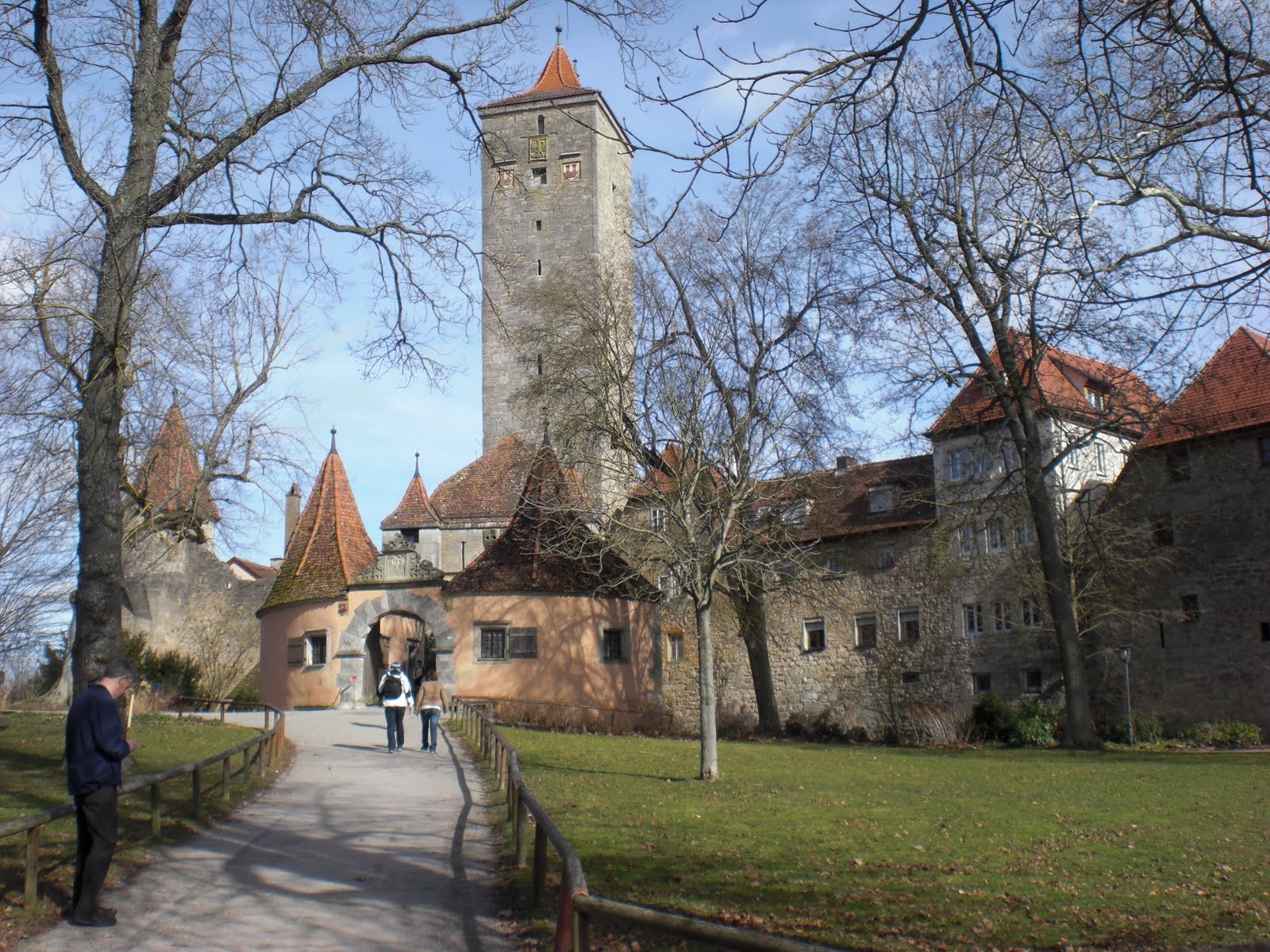
Rothenburg - One of Germany's top five!


We have visited enough sites now to acquire a sense when a place stands out and is worthy of particular attention.  If I were suggesting a must-see place Rothenburg would rank amongst the top 5.  I loved Rudesheim - the air tram and the trip down the Rhine for the sheer beauty which is Germany.  I enjoyed Kassel for the romance portrayed in its art, architecture and parks.  Trier grabbed me and took me back almost 2000 years with its historic Roman landscape.  The cathedral in Cologne deserves a place for its magnificent form and presence.

 Rothenburg is, in its entirety, a marvelous step back in time.  The 16th century comes alive in this little town.
It is entirely walled, unlike any other place we have seen to date.  It is quaint, cute, clean and true to life.  I was looking at a sketch in a store window of  a mid 16th century scene and as I examined it more carefully, (see street scene) I realized is was a scene of the very street I was on.

This was one instance where we opted to forgo an intriguing museum dedicated to the crime and punishment of the period.  We couldn't resist the photo opportunity though.


On entering the walled city, we climbed a narrow precipitous staircase and proceeded along a narrow wooden parapet that followed the outer wall which encircles the entire city.  From this vantage point, we had a birds eye view of the old inner city.  The wooden framework of the parapet retained the original dowels and the limited headroom spoke of its somewhat shorter former residents.  This could have been a long walk, so we abandoned our original intention to follow it for the duration and sought our first opportunity for egress. From there we proceed through the streets.  We were told by some American visitors that this day was a special one because the city was hosting special walking tours of the inner and outer portions of the walls.  During the course of the day we saw many Germans, many with walking sticks and some dressed in traditional garb purposefully walking the streets. There was a celebratory feel to the processions.  It was a gorgeous day and Arendje and I walked down one street after another
fully enjoying the experience.  We stopped and talked
to some of those we passed to get our bearings.
People were friendly and every shop we entered, they  readily recognized us as foreigners and spoke to us in English.  My initial reluctance to speak in English in some places has long since passed.  Most everyone  makes an attempt to speak to us in English, albeit the younger Germans tend to be much better at it than the older ones.

This is one place I have not made the effort to research.  I found that little was needed to add to this experience.  I have allowed my feelings and initial impressions to influence my comments.
Arendje said that this would be a place to return to see the 'Tour of the Night Watchman'.  It is a recounting of the important role of the night watchmen whose job was to keep everyone safe.  He goes around the city telling stories and legends.  This was the lowliest of jobs fraught with danger.  He carried a hellebarde which looks like an ax on a large stick.  Not one to mess with!

The shops also were fascinating, containing swords, armor
- a true tourist trap of accouterments for those who have a
hankering for German historical wares.This is the setting that inspired Walt Disney for the film Pinocchio and also Chitty
Chitty Bang Bang.  Arendje, of course, was caught up in the dresses and  period wardrobe.  She took this picture and looked
 longingly at it, imagining what it would look like on one of granddaughters.  She concluded she could make it for far less than what they were asking.  Even I could appreciate the colors and unique look  of the Bavarian traditional dress and styles.

We had a wonderful day!  You can be sure if any of you come this way, this is one place we will take you.  I am sure you would be captivated by the charming, isolated Bavarian town.


Sunday, February 21, 2010

Weisbaden - Hessischer Landtag

The Nassau name is inseparably connected with royalty in Europe. The Nassau line dominated Europe royalty for centuries, particularly Holland and Luxembourg.  My only real connection with that name originated with the city of Nassau in the Bahamas.

Since visiting a number of sites, I have felt it necessary to try to understand the relationships between the establishment of cities, the royal and ecclesiastical power brokers of the time and the geographical regions they controlled.  With this information in hand, the politics, disputes, and cultural flavor begins to make sense.

We visited the residence of Adolph, the Grand Duke of Nassau.  He ruled Hesse until the Prussian- Austrian War.  He sided with the losing side and was forced to abdicate.  He moved to Luxembourg and was the Grand Duke there until he died.  The state we now reside in is called Hesse, but it used to be called Nassau-Hesse.  It is the location of the Hesse Legislature governing a population of more than 6 million.  The building was a mix of old and new - to appreciate the facility, we have to go back to its heyday in the mid 19th century.
Wiesbaden, as I mentioned earlier, was the vacation spot of the rich and famous.  Visitors from all over Europe went to Wiesbaden to enjoy the baths and the casino.  More millionaires resided in this small city than any other part of Europe.  The mineral rich waters draw thousands of visitors annually. Locals could be seen drinking from the numerous fountains, claiming a host of health generating benefits.  I found it notably 'flavorful'.
On this tour we had a wonderful guide who went the extra mile to give our group of 30, an informative walk through this magnificent building.


The building pictured here is the equivalent of a city hall.  One side of this building is new as it was largely destroyed during the war.


This column -ade served as a facade to the local theater.  This is a unique landmark as it is the longest column supported structure in the world.


Wiesbaden goes back to Roman times as it was one of several locations that represent the northern line of defense of the Roman Empire against the Germanic tribes.


This visual anomaly was in the center of Wiesbaden, tucked up a side street.  The plaque states that the site also was part of a Roman fortification from the 3rd century.


 Wiesbaden was destroyed more than once during its tumultuous history. The architecture represents the luxurious  residences of late 19th century.  The design and ornate facades of the building clearly gave evidence of the wealth of former occupants.                                                                          

Sunday, February 14, 2010

Schenkenberg Natural History Museum


Thinking about taking in a natural history museum conjures up stuffed animals, lots of bones, rocks and of course dinosaurs.  Well, that is what we saw.  In this museum I wanted to take in more than what I typically do given the language barrier, hence I spent a little extra and rented an English audio device, to better appreciate the exhibits that captured my interest.  Like many of the others we visited, this museum was huge, with a multitude of displays covering every aspect of natural history - in fact it was too much.  Two or three hours in such a place exhausts the mental energy to take in the visual images and to process the accompanying imaginative cognitions the displays generate.
The first hall we entered was of birds, both small and great, from all parts of the world.  I wanted to stay there; those of you who know of my interest in birds can understand.  To see the rare Andean Condor, the western hemisphere's largest bird was particularly interesting for me.  Seven thousand square meters containing 5,000 individual exhibits with hundreds in the bird hall alone.  A few standouts for me included a royal albatross, another giant of a bird, the cinereous vulture and the bee hummingbird, the smallest bird in the world.  The other exhibits were equally impressive.  An Alaska moose which was well beyond the size of any moose I have seen, a Siberian brown bear, a rhinoceros, a gorilla,  an anaconda and a giant pangalin all provided a perspective of size that only proximity can permit.
Another hall had almost perfectly preserved animal specimens from a unique geological formation, combining sedimentation, subterainean gases, and low oxygen levels known as the Messel Pit .  Here were found miniature horses with skin and hair and fossilized stomach contents, and insects, fish, amphibians, reptiles, birds and plants.  By virtue of its unique composition, its age (49 million year-old site) it has been added to the World Heritage List.  It is not very far from Frankfurt---another place for us to visit.
This museum warrants a second visit.  I will probably do it on my own, when more time is available.  We continue to enjoy the company of the Taylor's on our more recent excursions. They are great company and are mobile enough to keep pace with our rather torrid pace.


We wanted to show the Taylor's Bad Homburg, which we have visited on two occasions already.  It comes highly recommended for a number of reasons. In the spring and summer we plan on making regular visits to the gorgeous park that surrounds the schloss.  This time we noted that we had not taken the opportunity to visit the church.  I figured we couldn't have an entry without a church represented.  We were glad we made this visit.  It is an evangelical church.  It was constructed in the late 19th century.
Now to appreciate this church, it to must be seen.  It was impressive enough on the outside to garner our attention, but it was the inside that captured the senses and our imagination.  The gold you see is actually a mosaic of tiny (i centimeter) tiles that cover the dome of this church providing a glistening colorful display  that is quite unlike anything we have seen to date.  Just imaging the time and effort that went into this work of art is mind boggling.  The tiles begin at shoulder height and continue upward to leave a spectacular display upon the senses.
Here again, our church attendance is climbing to what must be Guinness levels. We were in three churches this week. There are few more we have yet to visit.  Stay tuned! 


Sunday, February 7, 2010

Beautiful Cologne

We had anticipated a particularly eventful day when we decided to go to Cologne.  However I was not prepared for the visual impact of the Cologne Cathedral.  After having parked our car where we suspected was only a few blocks from the cathedral, we headed out along a narrow, busy street filled with throngs of shoppers on a grey, February morning. Characteristic of many German sites, you are unable to see what you are looking for until you are almost on top if it.  This was the case here.  We turned a corner and there it was, looming over us with a presence so strong it seemed to defy us not to look.  I had already visited many cathedrals, including Notre Dame, the Strasbourg Cathedral, Le Sacre Coeur, but this one left me in awe.  The facade is 86.5 metres wide, the largest of any church in the world, necessary in this cast to support the massive twin towers.  It was true in every respect to its Gothic design, in spite of having sustained construction for a period of 600 years.  As breathtaking as the exterior image was, we were to witness a unique interior design which managed to incorporate sufficient exterior light to dispel the normally dark, somber interior so typical of most Catholic churches of the same period.  It also holds the distinction of the highest height to width ratio of any medieval church.  This was made the more visually impressive by the stained glass panels extending from near the floor to the transits.  They, in and of themselves, are worth of careful study, not only for their beauty, but the stories they depicted in stunning backlit colours.  One stained glass panel was destroyed during the war and was replaced in the last few years completely replaced with intricate computer generated designe square patterns on the south wall.  As the sun moves, so too does the image of the refracted glass across the wall of the cathedral.  Our grey day of course did not permit us to witness this event, but the window itself gave my imagination ample opportunityto visualize the resplendent effect. This cathedral is recognized as a world heritage site by Unesco and is desribed as "en exceptional work of human creative genius.".  It also symbolizes to German's a memorial to their near two thousand years of Christian heritage. We had the good fortune of an English tour which provided detailed summaries of other valued artifacts within the
cathedral.  One such relic is a silver and gold sarcophagus holding what
they claim to be the remains of the three magi.  Indeed the contents have been analyzed and reported to be the clothing and bones of individuals very rich and of the time reputed time period.  The Christian artifact is said to be the most valuable (monetarily) Christian relic in existence.  Given the gold, silver and gems of which it is made, the size (several feet) and the workmanship it could easily be true.
Cologne dates back to 34 BC, the largest Roman outpost outside of Paris and Constantinople.  This cathedral was built over another ancient church back in the third century.
 
Unlike some other cathedrals, it never was neglected, although for a long period of time no construction took place.  It was not completed until the nineteenth century and was, for a time, the tallest structure in the world until the Washington monument was completed.  They had the good fortune to find the original plans for the towers and the rich Prussian merchants felt to make it a symbol of their Christian roots, albeit they were mostly protestant.  This edifice does not belong to the Catholic Church any longer, but is publicly owned and maintained.  A Catholic Archbishop retains this as his seat and services are held here.

We also spent part of our day exploring other museums,
 including a museum which once was the Gestapo Headquarters.
This museum is maintained as it was during the war.  The sub ground floors were designed as a bomb shelter and a cell block. Small, dingy rooms served as holding tanks for those accused of crimes against the Reich.  Almost anyone could be arrested and confined to these cells for months at a time. Gypsies, gays and lesbians, foreign nationals, members of underground resistance, and those simply accused by disgruntled neighbors fell victim to arrest, interrogation and torture.  Hand written scripts and pictures still visible on the walls tell the grim stories of their existence, hardships and woeful state.  Many of these were translated into English and described terrible abuses at the hands of the SS.  It was sad but there was in many of them a sense of hope and even peace.  Some knew death awaited them, yet they communicated in words their tranquility with it all.  The museum is called EL-DE Hause,  The EL DE  making reference to the first letters of the first and last name of a Jewish merchant who owned the building prior to the war.  This museum has been recognized with a presitigious International award honoring it for "The Best in Heritage" title.  I gather that this award honors those museums that take special care to accurately depict in form, detail and breadth the the history as it was.  Only one is given a year and only two are recognized with this honor in Germany.


We also visited a Roman Museum given the age of this beautiful city.  There were abundant remains of the Roman presence.  Cologne is also on the Rhine and represents one the most northerly advances of the Romans in their attempt to quell the troublesome Germanic tribes.  For three hundred years Roman influence permeated the culture and architecture of the region.  Many lived and died here.  I was under the impression that these Roman armies migrated back and fourth to Rome as circumstances required.  This was not the case.  Many lived their whole lives here - serving, retiring and dying.  Ancient grave sites with Roman gods are depicted in designs, sculptures and remains.  The ancestral Germans adopted much of the customs and beliefs of their Roman occupiers.  This museum was dedicated to the early period of Cologne history with focus on Roman architecture, craft, jewelery and customs.  The spacious exhibit captured the flavor of the period with thousands of displays.  A most enjoyable experience!


Saturday, January 30, 2010

Franfurt's Archeological Museum


We heard there was a temporary exhibit at the Archaologisches Museum in Frankfurt  and knowing the weather and roads were not conducive for travel, we opted to have a look.  It turned out to be much to my liking.  This collection and the artifacts covering a period of 36 thousand years from the neolithic through 1000 AD gave ample evidence that Germany has much to offer in terms of significant early finds.  For example the the lionheaded figurine at the right is one of the oldest human sculptures in the World.  It was found in 1939 in Germany.  The original is now on display in the Ulmer Museum (City Museum of Ulm) but some other museums own a copy of this unique find.  It is carved out of mammoth ivory and has a noted curve to it. The age 32,000 years was determined by nuclear dating and by comparing it with other finds in the same dig horizon.  This was significant because it represents the oldest large frame carving of its kind in the world.  
     The one on the left is the oldest
known human picture found in Europe; it is a very small ivory plate with a humanoid engraving on one side.  It was found in 1979 in Germany.  The material again is mammoth ivory and it was dated 35,000 years old, 3,000 years older than the lion head.  It is believed this was worn as an amulet and there are mysterious engravings on the back. The interpretation of the engraving suggest some kind of star map of the constellation of Orion and contains many bright stars.  The dots on the back could be used to aim at the stars and thus orient using the constellation of Orion as a guide.  It might have been an early compass.  The figurine on the right is of an elephant again carved from a
mammoth tusk and is one the oldest carving found in the same area, demonstrating that the paleolithic culture had the means and sophistication to produce these and similar works of art.
From the early stone age, people have been living and building in the central part of Germany.  There have been mounds discovered that revealed the sites and structures of inhabitants living 7,000 years ago.  For centuries the same site was used and reused.
One of the premier archeologists of this area is an American - Michael Joachim.. His digs, research and cumulative studies have contributed a great body of knowledge about the early inhabitants of Europe.  I have included his home page which has a well done visual of his digs and findings with fascinating background.
Another bit of archeological trivia that proves noteworthy is the uncovering of remains of an English princess in Germany - a 1000 year old Princess Diana.  The story behind her life and the circumstances leading to the discovery of her remains make for some interesting reading.

There is one other site worth mentioning; England has its Stonehenge, Germany has a similar site, unknown to most, that predates it by almost 2,000 years.  This stuff obviously captures my interest.  It seems it captures the interest of a good number of Germans as well.   I now know there are five or six comparable museums in Germany to visit and before I am through I hope to have visited most of them. My only regret is that most of the museums have only German scripts- not easy for this neophyte to decipher.

The main exhibit at the museum was a temporary exhibit [Tim and Ashton you may enjoy this]. We saw the Bayeux Tapestry (unfortunately a replica - the original is in Normandy) with accompanying museum pieces from throughout Germany relating the story of the 'last viking'.  The invasion of England by William, Duke of Normandy, which culminated in the Battle of Hastings in the year 1066, is considered historically as the 'last Viking raid.'   The history and the development of this conquest are related in a colourful, dramatic images and text on a tapestry.  It was in French and was close to a half the size of the original  (70 meters long and 50 centimetres wide.)  The one we saw included a script in French and German.  Fortunately I could read the French so I shared the story with Arendje as we followed the storyline through images.  The original was embroidered entirely on cotton.  It depicted elements of Norman and Norwegian culture of 1000 years ago.  I have included this link as it gives a full representation of what we saw and also tells the story.  You can relive our Saturday morning January 30th 2010, and go back a thousand years into the past.  Have fun!


Sunday, January 24, 2010

Offenbach Leather Museum


Offenbach is geographically, speaking a suburb of Frankfurt, although those from Offenbach would not want you to refer to it that way. Once the center of a thriving leather industry, since World War II, it has declined. What remains is a museum that portrays, in a singular way, the role leather played in the cultural history of, not only Germany but the world.Selecting pictures for inclusion here was almost pointless. There were over 15 thousand exhibits. This link will give you some idea of what we saw.
 Posting pictures would  hardly begin to express

the scope of this craft. As we wandered through this museum,  
I was left with a broadened perspective, an appreciation of another 
art form and a taste of the diversity to which leather was used
through the generations. I believe there is one other leather 
museum in the world - in Chicago. Offenbach lays  claim to being
the center of international exhibits on the best and latest in
leather works from purses and luggage to footwear.

We were shown the basic principles of the leather goods industry

with examples from the work of bookbinders and saddlers. 
The exhibit was worldwide and attempted to encompass the 
changing variety of goods through the ages.

One section on leather working techniques displays models of 

the various tanning processes together with the different types 
of leather and dyeing methods, and demonstrates properties of
 leather such as elasticity, tensile strength, susceptibility to 
splitting and resistance to water and fire. There were ample 
displays of "exotic" leathers such as crocodile, snake and lizard
skin together with goods made of them. Issues surrounding
 the protection of endangered species are also covered here.

They had a well laid out display of leather from Inuit, native 

leather works and cowboy duds, western saddles from various 
eras and full size displays depicting scenes with how and where
 the various leathers were used. Again I have to admire the 
German eye for detail, precision and historical accuracy.

The museum has a major collection of shadow puppets from 

Thailand, India, China, Indonesia, Egypt and Turkey.
Exquisitely cut from the fine leather and painted with
iridescent colours, the puppets were operated by rods from 
below, to present plays against a translucent back-lit screen. 
Unusual exhibits include a set of Chinese shadow puppets 
that belonged to Emperor Qianlong (1711-1799), and a 
number of large Thai shadowfigures. Few museums 
in the world can boast such an outstanding shadow
puppet collection.


There was a shoe museum which was more an artistic 
rendition of styles and ornamental features than anything 
anyone would typically wear. I missed this part as I got a 
phone call as I often do at various and sundry times 
relating to my assignment. Some of these would make 
interesting stories too.

We took this tour with 25 senior missionaries couples and

sisters.  We have lived long enough to have witnessed a
generation when the leather industry is rapidly declining.
I remember my German friends in Norther Ontario walking
around in their lederhosen; luggage of any quality was 
always leather.


Sunday, January 17, 2010

Colloquy of Marburg


Choosing where to go and what to see in Central Germany represents a challenge.  The choices seem endless, each one providing a new learning experience and adventure. Marburg holds appeal on a number of counts.  Perhaps of pre-eminent importance is its distinction as a university town .  It was founded in 1527. Phillip(the Magnanimous) designated his university as Protestant, thus becoming the world's first and consequently, oldest Protestant University. The university was the first in the world to create a professorship in chemistry in 1609.  The Brothers Grimm studied in Marburg in 1806, after which a discipline in German Studies was established.  Rapunzel, one of the Grimm's Brothers' best loved fairy tales was first published in 1602.  Its best know line is, "Rapunzel, Rapunzel let down your hair."    The tower to which he was referring is here in Marburg.

The first Noble Prize for Medicine went to Marburg's Emil von Behring in 1901.  It has one of the five high security labs in Europe and was responsible for identifying the deadly Marburg virus. You will remember it as the hemorrhagic virus of the ebola class, that infected many in East Africa.  It has an international reputation in chemistry, medicine and psychology.  This town of 80,000 thousand hums with the energy of its student population.  Just about everyone either goes to school here or is employed by the university.  This town's character is built around the youthful populations with pubs and clubs on every street.  There is an element of the counter-culture here, evidenced by some of the lively protests students engage in.


The enchantment of this city lies in its topography.  Walking out of the tourist information kiosk, we turned right, went twenty meters and took an elevator up two flights to the next street.  Upon exiting a narrow access alley, we came out on to the scene above.  Half timbered houses lined the narrow cobblestone lanes, winding up and around picturesque shops and boutiques.  The cold weather and our tight schedule kept us moving briskly.  We climbed up several flights of stairs towards the Schloss perched precariously above us.  We did a lot of climbing that day.  Jacob Grimm pointedly commented "there are more steps on the streets than in the houses".

We went with Gary and Melody Taylor who also work as Mental Health Advisors.  Gary Taylor  has three books to his credit in the field of mental health.  His best selling book "Divine Union" was followed by "Perfect Parent".  He says his best one is "Life is Easy - We Just Decide Its Hard."  He states he had no choice on the title.  This is the one that I am interested in.  He comes very well prepared for this assignment.  We are going to enjoy working with them.


The cultural history museum in the Marburg Castle is maintained by the university and houses a wide assortment of paraphanailia of central Germany from the Bronze Age to 20th century.  The variety and scope of the collection would appeal to just about every taste.  There was the apparel of the aristocracy,  the common folk and the armor of knights, weaponry, furnishings, paintings, tapestries, model reconstruction of churches and castles, an extensive display of porcelain covering many generations, toys, doll houses, stoves, medical utensils and every day household belongings.  In the Bronze Age display there were urns, vessels, tools, bones and a full skeleton as originally found.  One feature unique to this museum was the way they provided glass enclosed viewing areas into the catacombs of the castle. Very cool!

One large painting depicted a gathering of Early Reformers of 1529 under the auspices of the resident Landgrave Phillip of Hesse known as the Coloquy of Marburg.  Here Luther and  Ulrich Zwingli had what was to be a seminal event.  Luther still maintained the vestiges of his Catholic belief system advocating for the Eucherist as practice by the Catholic Faith.  He argued that during the Sacrament, Christ's body was present. Zwingli argued against this, stating this was a metaphor and symbolic of the blood and body of Christ.  This ultimately led to "The Reformers" breaking away from the then emerging Protestant Movement.

A number of Zwingli's Articles of Faith departed sharply from that of the Catholic Church, but also set the stage for closer adherence to biblically based doctrine.  He took extreme exception to the pomp and sophistry, the justification for all the relics, infant baptism and indulgences.  As I studied Zwingli's contributions, I realize he deserves more credit than what history has allotted him.  Calvin, another Swiss reformer who followed after Zwingli, essentially incorporated most of his tenets into his own schema.  In some ways, Calvin's tenets were regressive, more conformist to preexisting beliefs and practices than the highly educated and enlightened Zwingli.

Our last stop was at the Elizabethan Church.  In earlier blogs, I made mention of Elizabeth who gave so selflessly to the poor.  She gained great favor among the peasant class.  The loss of her husband of only a few years and the trials of her charitable work took their toll.  She died at the age of 24 and was buried in Marburg.

Inside are some incredible works of art. The tomb of Elizabeth is glass encased with what look like gold and precious stones.  I think Elizabeth would have rejected outright such a display, preferring to give of such riches to the sick and needy.  The following is taken from some historical writings: "On Good Friday, 1228, in the Franciscan House at Eisenach, Elizabeth formally renounced the world; she received from Conrad the dress of the Third Order of St. Francis. In the summer of 1228, she built the Franciscan Hospital at Marburg and on its completion, devoted herself entirely to the care of the sick, especially to those afflicted with debilitating and disfiguring diseases.
Soon after the death of Elizabeth, miracles were reported to occur at her grave in the church, especially miracles of healing.  At Pentecost of the year 1235, the solemn ceremony of canonization of the "greatest woman of the German Middle Ages" was celebrated by Gregory IX at Perugia, with Conrad present.   Conrad had written in support of her canonization, a letter, of which a portion is reproduced here:  Elizabeth was a lifelong friend of the poor and gave herself entirely to relieving the hungry. She ordered that one of her castles should be converted into a hospital in which she gathered many of the weak and feeble. She generously gave alms to all who were in need, not only in that place but in all the territories of her husband's empire. She spent all her own revenue from her husband's four principalities, and finally she sold her luxurious possessions and rich clothes for the sake of the poor.
Twice a day, in the morning and in the evening, Elizabeth went to visit the sick. She personally cared for those who were particularly repulsive; to some she gave food, to others clothing; some she carried on her own shoulders, and performed many other kindly services. Her husband, of happy memory, gladly approved of these charitable works. Finally, when her husband died, she sought the highest perfection; filled with tears, she implored me to let her beg for alms from door to door. Good Friday of that year, when the altars had been stripped, she laid her hands on the altar in a chapel in her own town, where she had established the Friars Minor, and before witnesses she voluntarily renounced all worldly display and everything that our Savior in the gospel advises us to abandon. Even then she saw that she could still be distracted by the cares and worldly glory which had surrounded her while her husband was alive. Against my will she followed me to Marburg. Here in the town she built a hospice where she gathered together the weak and the feeble. There she attended the most wretched and contemptible at her own table.
Apart from those active good works, I declare before God that I have seldom seen a more contemplative woman.
Before her death I heard her confession. When I asked what should be done about her goods and possessions, she replied that anything which seemed to be hers belonged to the poor. She asked me to distribute everything except one worn-out dress in which she wished to be buried. When all this had been decided, she received the body of our Lord. Afterward, until vespers, she spoke often of the holiest things she had heard in sermons. Then, she devoutly commended to God all who were sitting near her, and as if falling into a gentle sleep, she died.
In August of 1235, soon after her canonization, the corner-stone of the beautiful Gothic Franciscan church of St. Elizabeth was laid at Marburg.  On May 1, 1236, Emperor Frederick II attended the taking-up of the body of the saint; in 1249, the remains were placed in the choir of the church of St. Elizabeth.