Sunday, March 28, 2010

Bamberg- A World Heritage Site

Bamberg was recognized as a Unesco World Heritage site...''as the layout and architecture of medieval and renaissance Bamberg exerted a strong influence on urban form and evolution in the lands of central Europe from the 11th century onwards.  Secondly, Bamberg is an outstanding representative example of an early medieval town in central Europe, both in its plan and its many surviving ecclesiastical and secular buildings."  It escaped the ravaging effects of allied bombing due to an artillery factory on the outskirts of the city.
The town was laid out as a cross according to medieval planning, with the churches of St. Michael, St. Stephen, St. Gangolf, and St. Jacob at the four cardinal points.  It was intended to be a second Rome and Henry II ruled here from 1002 to 1024.  He was buried along with the only Pope buried outside of Rome.  He was the last Roman Emperor of the Ottonian Dynasty, ruled Italy and Germany and is the only German king to be canonized.  He lead numerous campaigns on their behalf as a strong advocate of the Catholic church and its efforts to christianize much of Europe.

The city prospered in the following centuries and subsequent efforts to retain its heritage in architecture, planning and aesthetic appeal allowed us to take in an impressive display of art in a variety of forms.  We explored street after street, taking in the grand old churches, some over a thousand years old, palatial residences, beautiful gardens and splendid examples of medieval planning and architecture.  I was anxious to make the most of the day and Arendje had to  constrain me several times or I would have left  my travelling companions far behind.
I counted 14 museums in total, devoted to everything from market gardeners and wine growers  to a missionary museum.  There was a royal Strasbourg porcelain collection to a fire brigade museum.  We did not have time to venture into any.  There was too much to see outside.  We got a little wet, but not enough to dampen our spirits.  The Taylor's are beginning to think there is no such thing as sunshine in Germany on a Saturday.
The city of Bamberg is built on seven hills as was Rome and so we got our exercise hiking up and down to take in the landmark sites. This trip acquired its standing amongst the best sites for their number and grandeur.  Each church captured our attention, as each maintained its integrity by incorporating diverse forms of art, architecture and layout.

The Imperial Cathedral to the right housed impressive rock sculptures and the tomb of Pope Clemens II in the 13th century and the marble tomb of the imperial couple.  The cathedral shares
elements of both Romanesque and Gothic given the long period of its construction. It was founded 1004 and consecrated in 1012.  It burned down twice over the next two centuries.  It also has an exquisite sculpture of an equestrian horseman.  The square on which the cathedral stands is spectacular.   It is reminiscent of Place de la Concorde in Paris.

This too ranks as a memorable trip.  I do not know if one can find a place packed so closely with so many fascinating things to see.

This would be worth another trip if only to delve more deeply into the history and the characters who shaped this city. There are over 30 antique and art shops.  It has what they refer to as a little Venice, with a number of river or water channels bisecting the city center.   Bridges crisscross these channels providing opportune places to enjoy the scenery.  This is a beer town with nine breweries still operating today.  They take their beer seriously here.  Every street seemed to have its beer garden and they have what they affectionately call their 'Brewery Trail'.


Sunday, March 21, 2010

Limburg - cheese and Wetzlar - optics


Limburg  is a name synonamous with stinky cheese.  My first encounter with limburger cheese was in France 40 years ago. The bacterium used to ferment limburger cheese is found on human skin and is partially responsible for body odor.  So pronounced is this odor that mosquitoes are as attracted to smelly feet as they are to limburger cheese.  They use this cheese to attract malaria mosquitoes in parts of Africa.  Reacquainting myself with this pungent odor was not the motivation to make this trip yet I thought there was a good chance of an odoriferous encounter.  The outdoor market in Limburg had ample supply.
                                                                                                                                                                                          
Limburg has other noteworthy attractions and is particularly noted for the number of timber frame houses. This made for a pleasant and appealing promenade through the altstadt (old town).  Within thirty minutes of Frankfurt, it is ideal for a day trip.  It also boasts the oldest free standing house in Germany, built in 1289.  Most of the others are 17th and 18th century.  The cathedral is a beautiful example of Romanesque architiecture built between 1200 and 1235.  This building has been well cared for and looks equally impressive inside and out.  The stain glass has been replaced and the entire work was done by one of Germany's most gifted craftsman.

Weztlar, which is about a half hour from Limburg is a city of similar size and with a parallel history.  It also offers elements that are unique, even fascinating, for someone whose interests extend to the history of optical technology.   This is the home of Leica camera and world class innovators and inventors in optics.  Ernst Leitz's name is attached to some the earliest, and still  regarded as the finest, microscopes in the world.   His life, the evolution of the company he founded, the legacy to Jews whose lives he saved during World War II, his contributiions to the field of optics and his followers, whose claim in the history books goes to the first functional 35 mm camera, give reason to do a little research.  We were enticed into a rather unique museum dedicated to this city's premier industry.  It was called  Viseum (Innovation in Optics).  There are 14 regional companies dedicated to high tech and the museum attempts to amalgamate their singular contributions through an interactive, learning experience, mostly related to optics.  Of course, it was all in German, yet it still was interesting and informative.  Every Leica camera ever made was on display as well as the first simple microscopes through advanced electron microscopes.  It explained how finely crafted lenses are formed and allowed us to view a host of items at various magnifications.  All in all, well worth the entry fee, as it expanded the scope of our appreciation of this great country.


This cathedral along with the schloss was built from 1200 to 1225.
It overlooked the town below..  The city wall  was torn down in the 1880s leaving only telltale signs of its former existence.


Sunday, March 14, 2010

Worms and the birth of Protestantism


On the trail of Martin Luther - we have followed this man from Eisenach and Wartburg in the former East Germany to the resting place of some of his work in the Gutenberg Museum and now here in Worms, where a Diet was held that for all intents, began the official Reformation.   Almost a century before Luther, Jan Huss, another reformer of a more pious lean, had suffered death by fire as a heretic.  He  prophesied: "You roast a lean goose [Huss] today, but from my ashes a swan will ascend, in a hundred years, that you cannot roast." Luther apparently regarded himself as the swan who had come to reform the church.

The Diet was called by the ruling authorities with the idea of furthering their political agenda.  The Catholic Church wanted to put a halt to Luther's dissenting views. Unfortunately for the church, the journey to the Imperial Diet did not embody the repentance the church had hoped for, nor the hoped for political ends the aristocracy was seeking.  The journey to Worms was more like a victory march; Luther was welcomed enthusiastically in all of the towns he went through.  He preached in Erfurt, Gotha and Eisenach.  (Erfurt is for another trip) He arrived in Worms on April 16, 1521 and was also cheered and welcomed by the people there.  His passionate and outspoken manner garnered both anger and appeal.
Luther auf dem Reichstag zu Worms

Luther's appearance at the Imperial Diet was described as objective, clever and well thought out. He had to appear before the Emperor twice; each time he was clearly told to take back his teachings. Luther didn't see any proof against his theses or views which would move him to recant:  "Unless I am convinced by Scripture and plain reason - I do not accept the authority of the popes and councils, for they have contradicted each other - my conscience is captive to the Word of God.  I cannot and I will not recant anything for to go against conscience is neither right nor safe.  God help me.  Amen.  "The infamous saying, "Here I stand.  I cannot do otherwise." does not come from Luther.

After he left the negotiation room, he said, "I am finished."  He was for finished for a time.  Luther was dismissed, and not arrested because he had a letter of safe conduct (Schutzbrief) which guaranteed him 21 days of safe travel through the land.  He headed home on April 25.  When Luther and the princes who supported him left Worms, the emperor imposed an Imperial Act (Wormser Edikt).  Luther is declared an outlaw (he may be killed by anyone without threat of punishment).  On the trip home, Elector Friedrich the Wise allowed Luther to be kidnapped on May 4; Luther knew about it beforehand.  This took place on the one hand to guarantee Luther's safety and on the other hand, to let him disappear from the scene for a short while.  There were even rumors of Luther's death.  This action also helped the Elector not to endanger himself because he could have been held liable for protecting an outlaw and heretic.  Luther was taken to the secluded Wartburg and the Reformation had time to stabilize and strengthen itself.  We visited this site as referenced in an earlier blog and acquired a sense of the austere and isolated conditions Luther was forced to endure.  Having spent many years as a monk probably prepared him for this cloistered existence.

In Worms we followed the trail of his stay with a guided tour in English.  The town had doubled in size from about 5000 at the time in anticipation of the Diet.  Available lodging was at a premium; a bed was  made available for Luther and now only a plaque on the wall of a modern building tells the story of his stay in this location.

Worms is a city of considerable antiquity going back to Celtic times, then Roman and under continous habitation of thousands of years.  The city was completely destroyed more than once, the last time during the Allied bombing of 1945.  Attempts to target chemical plants on the outskirts of town were missed and much of the city core was destroyed.  Nevertheless, there were some important centuries old buildings left largely intact.  This beautiful Romanesque cathedral was spared.  It dates from the 12th century and contains beautiful stain glass and guilded altars.

This city is steeped in history but not a lot remains to bear witness of it.  Museums serve to recount the tales of bygone eras. Worms attempts to capture the past through art, literature and playing upon the imagination of its visitors.  Some vestiges still remain. For example, the oldest Jewish cemetery in Europe is located here.  In addition, the churches represent a cross section of architectural styles from Romanesque to modern. The first impression leaves little to indicate it's rich prior history.  I had to dig a little deeper to find the gems, but they are here!


Sunday, February 28, 2010

Rothenburg - One of Germany's top five!


We have visited enough sites now to acquire a sense when a place stands out and is worthy of particular attention.  If I were suggesting a must-see place Rothenburg would rank amongst the top 5.  I loved Rudesheim - the air tram and the trip down the Rhine for the sheer beauty which is Germany.  I enjoyed Kassel for the romance portrayed in its art, architecture and parks.  Trier grabbed me and took me back almost 2000 years with its historic Roman landscape.  The cathedral in Cologne deserves a place for its magnificent form and presence.

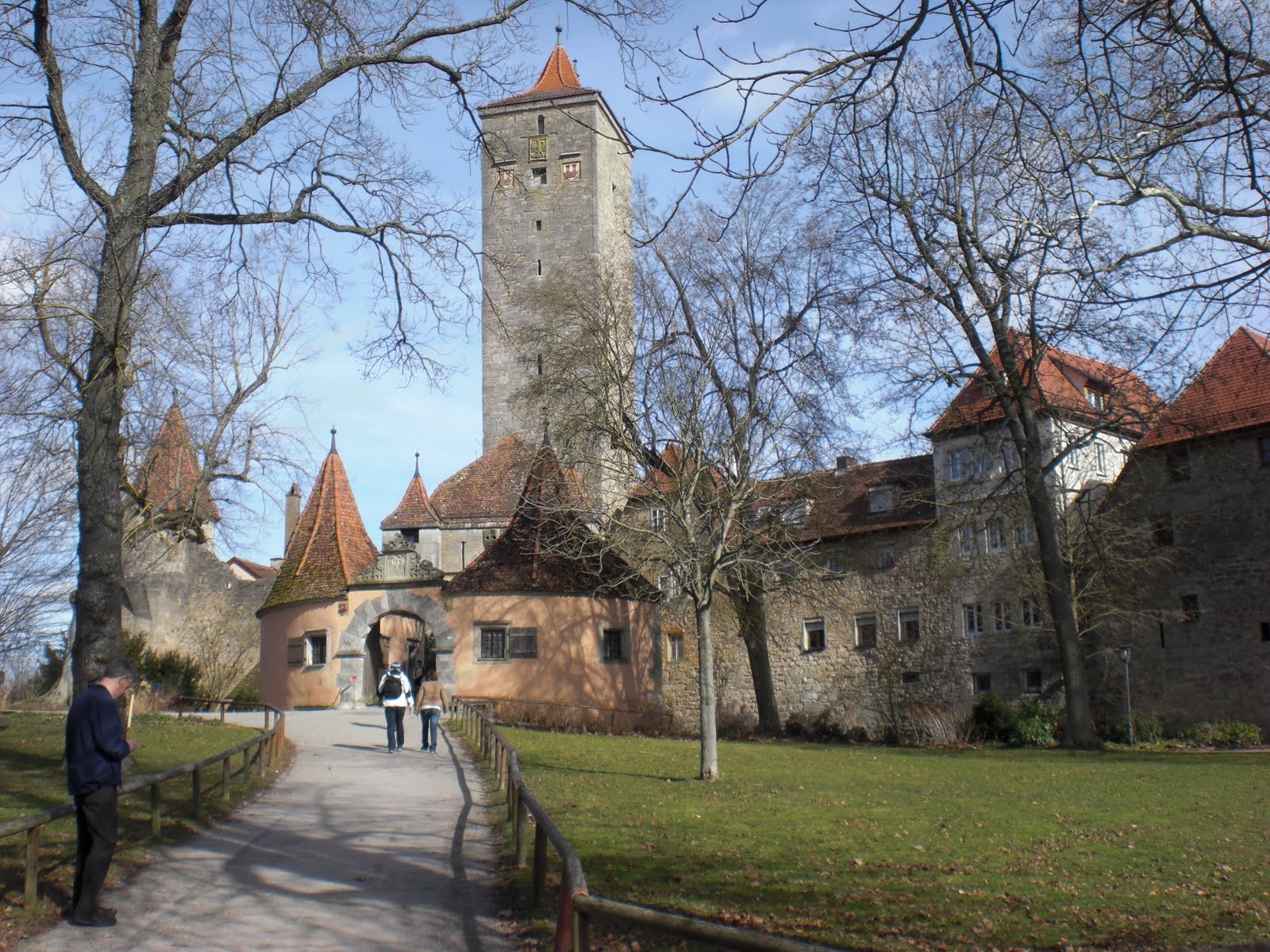
 Rothenburg is, in its entirety, a marvelous step back in time.  The 16th century comes alive in this little town.
It is entirely walled, unlike any other place we have seen to date.  It is quaint, cute, clean and true to life.  I was looking at a sketch in a store window of  a mid 16th century scene and as I examined it more carefully, (see street scene) I realized is was a scene of the very street I was on.

This was one instance where we opted to forgo an intriguing museum dedicated to the crime and punishment of the period.  We couldn't resist the photo opportunity though.


On entering the walled city, we climbed a narrow precipitous staircase and proceeded along a narrow wooden parapet that followed the outer wall which encircles the entire city.  From this vantage point, we had a birds eye view of the old inner city.  The wooden framework of the parapet retained the original dowels and the limited headroom spoke of its somewhat shorter former residents.  This could have been a long walk, so we abandoned our original intention to follow it for the duration and sought our first opportunity for egress. From there we proceed through the streets.  We were told by some American visitors that this day was a special one because the city was hosting special walking tours of the inner and outer portions of the walls.  During the course of the day we saw many Germans, many with walking sticks and some dressed in traditional garb purposefully walking the streets. There was a celebratory feel to the processions.  It was a gorgeous day and Arendje and I walked down one street after another
fully enjoying the experience.  We stopped and talked
to some of those we passed to get our bearings.
People were friendly and every shop we entered, they  readily recognized us as foreigners and spoke to us in English.  My initial reluctance to speak in English in some places has long since passed.  Most everyone  makes an attempt to speak to us in English, albeit the younger Germans tend to be much better at it than the older ones.

This is one place I have not made the effort to research.  I found that little was needed to add to this experience.  I have allowed my feelings and initial impressions to influence my comments.
Arendje said that this would be a place to return to see the 'Tour of the Night Watchman'.  It is a recounting of the important role of the night watchmen whose job was to keep everyone safe.  He goes around the city telling stories and legends.  This was the lowliest of jobs fraught with danger.  He carried a hellebarde which looks like an ax on a large stick.  Not one to mess with!

The shops also were fascinating, containing swords, armor
- a true tourist trap of accouterments for those who have a
hankering for German historical wares.This is the setting that inspired Walt Disney for the film Pinocchio and also Chitty
Chitty Bang Bang.  Arendje, of course, was caught up in the dresses and  period wardrobe.  She took this picture and looked
 longingly at it, imagining what it would look like on one of granddaughters.  She concluded she could make it for far less than what they were asking.  Even I could appreciate the colors and unique look  of the Bavarian traditional dress and styles.

We had a wonderful day!  You can be sure if any of you come this way, this is one place we will take you.  I am sure you would be captivated by the charming, isolated Bavarian town.


Sunday, February 21, 2010

Weisbaden - Hessischer Landtag

The Nassau name is inseparably connected with royalty in Europe. The Nassau line dominated Europe royalty for centuries, particularly Holland and Luxembourg.  My only real connection with that name originated with the city of Nassau in the Bahamas.

Since visiting a number of sites, I have felt it necessary to try to understand the relationships between the establishment of cities, the royal and ecclesiastical power brokers of the time and the geographical regions they controlled.  With this information in hand, the politics, disputes, and cultural flavor begins to make sense.

We visited the residence of Adolph, the Grand Duke of Nassau.  He ruled Hesse until the Prussian- Austrian War.  He sided with the losing side and was forced to abdicate.  He moved to Luxembourg and was the Grand Duke there until he died.  The state we now reside in is called Hesse, but it used to be called Nassau-Hesse.  It is the location of the Hesse Legislature governing a population of more than 6 million.  The building was a mix of old and new - to appreciate the facility, we have to go back to its heyday in the mid 19th century.
Wiesbaden, as I mentioned earlier, was the vacation spot of the rich and famous.  Visitors from all over Europe went to Wiesbaden to enjoy the baths and the casino.  More millionaires resided in this small city than any other part of Europe.  The mineral rich waters draw thousands of visitors annually. Locals could be seen drinking from the numerous fountains, claiming a host of health generating benefits.  I found it notably 'flavorful'.
On this tour we had a wonderful guide who went the extra mile to give our group of 30, an informative walk through this magnificent building.


The building pictured here is the equivalent of a city hall.  One side of this building is new as it was largely destroyed during the war.


This column -ade served as a facade to the local theater.  This is a unique landmark as it is the longest column supported structure in the world.


Wiesbaden goes back to Roman times as it was one of several locations that represent the northern line of defense of the Roman Empire against the Germanic tribes.


This visual anomaly was in the center of Wiesbaden, tucked up a side street.  The plaque states that the site also was part of a Roman fortification from the 3rd century.


 Wiesbaden was destroyed more than once during its tumultuous history. The architecture represents the luxurious  residences of late 19th century.  The design and ornate facades of the building clearly gave evidence of the wealth of former occupants.                                                                          

Sunday, February 14, 2010

Schenkenberg Natural History Museum


Thinking about taking in a natural history museum conjures up stuffed animals, lots of bones, rocks and of course dinosaurs.  Well, that is what we saw.  In this museum I wanted to take in more than what I typically do given the language barrier, hence I spent a little extra and rented an English audio device, to better appreciate the exhibits that captured my interest.  Like many of the others we visited, this museum was huge, with a multitude of displays covering every aspect of natural history - in fact it was too much.  Two or three hours in such a place exhausts the mental energy to take in the visual images and to process the accompanying imaginative cognitions the displays generate.
The first hall we entered was of birds, both small and great, from all parts of the world.  I wanted to stay there; those of you who know of my interest in birds can understand.  To see the rare Andean Condor, the western hemisphere's largest bird was particularly interesting for me.  Seven thousand square meters containing 5,000 individual exhibits with hundreds in the bird hall alone.  A few standouts for me included a royal albatross, another giant of a bird, the cinereous vulture and the bee hummingbird, the smallest bird in the world.  The other exhibits were equally impressive.  An Alaska moose which was well beyond the size of any moose I have seen, a Siberian brown bear, a rhinoceros, a gorilla,  an anaconda and a giant pangalin all provided a perspective of size that only proximity can permit.
Another hall had almost perfectly preserved animal specimens from a unique geological formation, combining sedimentation, subterainean gases, and low oxygen levels known as the Messel Pit .  Here were found miniature horses with skin and hair and fossilized stomach contents, and insects, fish, amphibians, reptiles, birds and plants.  By virtue of its unique composition, its age (49 million year-old site) it has been added to the World Heritage List.  It is not very far from Frankfurt---another place for us to visit.
This museum warrants a second visit.  I will probably do it on my own, when more time is available.  We continue to enjoy the company of the Taylor's on our more recent excursions. They are great company and are mobile enough to keep pace with our rather torrid pace.


We wanted to show the Taylor's Bad Homburg, which we have visited on two occasions already.  It comes highly recommended for a number of reasons. In the spring and summer we plan on making regular visits to the gorgeous park that surrounds the schloss.  This time we noted that we had not taken the opportunity to visit the church.  I figured we couldn't have an entry without a church represented.  We were glad we made this visit.  It is an evangelical church.  It was constructed in the late 19th century.
Now to appreciate this church, it to must be seen.  It was impressive enough on the outside to garner our attention, but it was the inside that captured the senses and our imagination.  The gold you see is actually a mosaic of tiny (i centimeter) tiles that cover the dome of this church providing a glistening colorful display  that is quite unlike anything we have seen to date.  Just imaging the time and effort that went into this work of art is mind boggling.  The tiles begin at shoulder height and continue upward to leave a spectacular display upon the senses.
Here again, our church attendance is climbing to what must be Guinness levels. We were in three churches this week. There are few more we have yet to visit.  Stay tuned! 


Sunday, February 7, 2010

Beautiful Cologne

We had anticipated a particularly eventful day when we decided to go to Cologne.  However I was not prepared for the visual impact of the Cologne Cathedral.  After having parked our car where we suspected was only a few blocks from the cathedral, we headed out along a narrow, busy street filled with throngs of shoppers on a grey, February morning. Characteristic of many German sites, you are unable to see what you are looking for until you are almost on top if it.  This was the case here.  We turned a corner and there it was, looming over us with a presence so strong it seemed to defy us not to look.  I had already visited many cathedrals, including Notre Dame, the Strasbourg Cathedral, Le Sacre Coeur, but this one left me in awe.  The facade is 86.5 metres wide, the largest of any church in the world, necessary in this cast to support the massive twin towers.  It was true in every respect to its Gothic design, in spite of having sustained construction for a period of 600 years.  As breathtaking as the exterior image was, we were to witness a unique interior design which managed to incorporate sufficient exterior light to dispel the normally dark, somber interior so typical of most Catholic churches of the same period.  It also holds the distinction of the highest height to width ratio of any medieval church.  This was made the more visually impressive by the stained glass panels extending from near the floor to the transits.  They, in and of themselves, are worth of careful study, not only for their beauty, but the stories they depicted in stunning backlit colours.  One stained glass panel was destroyed during the war and was replaced in the last few years completely replaced with intricate computer generated designe square patterns on the south wall.  As the sun moves, so too does the image of the refracted glass across the wall of the cathedral.  Our grey day of course did not permit us to witness this event, but the window itself gave my imagination ample opportunityto visualize the resplendent effect. This cathedral is recognized as a world heritage site by Unesco and is desribed as "en exceptional work of human creative genius.".  It also symbolizes to German's a memorial to their near two thousand years of Christian heritage. We had the good fortune of an English tour which provided detailed summaries of other valued artifacts within the
cathedral.  One such relic is a silver and gold sarcophagus holding what
they claim to be the remains of the three magi.  Indeed the contents have been analyzed and reported to be the clothing and bones of individuals very rich and of the time reputed time period.  The Christian artifact is said to be the most valuable (monetarily) Christian relic in existence.  Given the gold, silver and gems of which it is made, the size (several feet) and the workmanship it could easily be true.
Cologne dates back to 34 BC, the largest Roman outpost outside of Paris and Constantinople.  This cathedral was built over another ancient church back in the third century.
 
Unlike some other cathedrals, it never was neglected, although for a long period of time no construction took place.  It was not completed until the nineteenth century and was, for a time, the tallest structure in the world until the Washington monument was completed.  They had the good fortune to find the original plans for the towers and the rich Prussian merchants felt to make it a symbol of their Christian roots, albeit they were mostly protestant.  This edifice does not belong to the Catholic Church any longer, but is publicly owned and maintained.  A Catholic Archbishop retains this as his seat and services are held here.

We also spent part of our day exploring other museums,
 including a museum which once was the Gestapo Headquarters.
This museum is maintained as it was during the war.  The sub ground floors were designed as a bomb shelter and a cell block. Small, dingy rooms served as holding tanks for those accused of crimes against the Reich.  Almost anyone could be arrested and confined to these cells for months at a time. Gypsies, gays and lesbians, foreign nationals, members of underground resistance, and those simply accused by disgruntled neighbors fell victim to arrest, interrogation and torture.  Hand written scripts and pictures still visible on the walls tell the grim stories of their existence, hardships and woeful state.  Many of these were translated into English and described terrible abuses at the hands of the SS.  It was sad but there was in many of them a sense of hope and even peace.  Some knew death awaited them, yet they communicated in words their tranquility with it all.  The museum is called EL-DE Hause,  The EL DE  making reference to the first letters of the first and last name of a Jewish merchant who owned the building prior to the war.  This museum has been recognized with a presitigious International award honoring it for "The Best in Heritage" title.  I gather that this award honors those museums that take special care to accurately depict in form, detail and breadth the the history as it was.  Only one is given a year and only two are recognized with this honor in Germany.


We also visited a Roman Museum given the age of this beautiful city.  There were abundant remains of the Roman presence.  Cologne is also on the Rhine and represents one the most northerly advances of the Romans in their attempt to quell the troublesome Germanic tribes.  For three hundred years Roman influence permeated the culture and architecture of the region.  Many lived and died here.  I was under the impression that these Roman armies migrated back and fourth to Rome as circumstances required.  This was not the case.  Many lived their whole lives here - serving, retiring and dying.  Ancient grave sites with Roman gods are depicted in designs, sculptures and remains.  The ancestral Germans adopted much of the customs and beliefs of their Roman occupiers.  This museum was dedicated to the early period of Cologne history with focus on Roman architecture, craft, jewelery and customs.  The spacious exhibit captured the flavor of the period with thousands of displays.  A most enjoyable experience!